Please Don't Use Typos to Prove You're Human (A 2026 Content Visibility Survival Guide)
Just 7 no fuss, tried-and-true marketing strategies to survive the AI epoch and actually get seen. Plus a little fussing, just for fun.

Who’s excited for the latest AI insights? 🙌
Just kidding. I promise. Please keep reading.
As a content marketer (who chats with Gemini all day and wistfully reads anti-tech polemicists after hours), I admit to my own chagrin that reading is something I’ve had trouble with lately. And not just because bot reliance is turning my brain into low-sodium canned soup.
Most of the content coming out in our industry is simultaneously too stressful and too boring to read. AI, AI SEO, AEO, GEO … Everyone feels compelled to blab about it, and there’s not much that’s worth listening to (except my colleague Josh’s blog, linked above).
Least of all the AI explainer articles that look suspiciously like insider information. How many of these posts have you seen on LinkedIn in the last 48 hours?
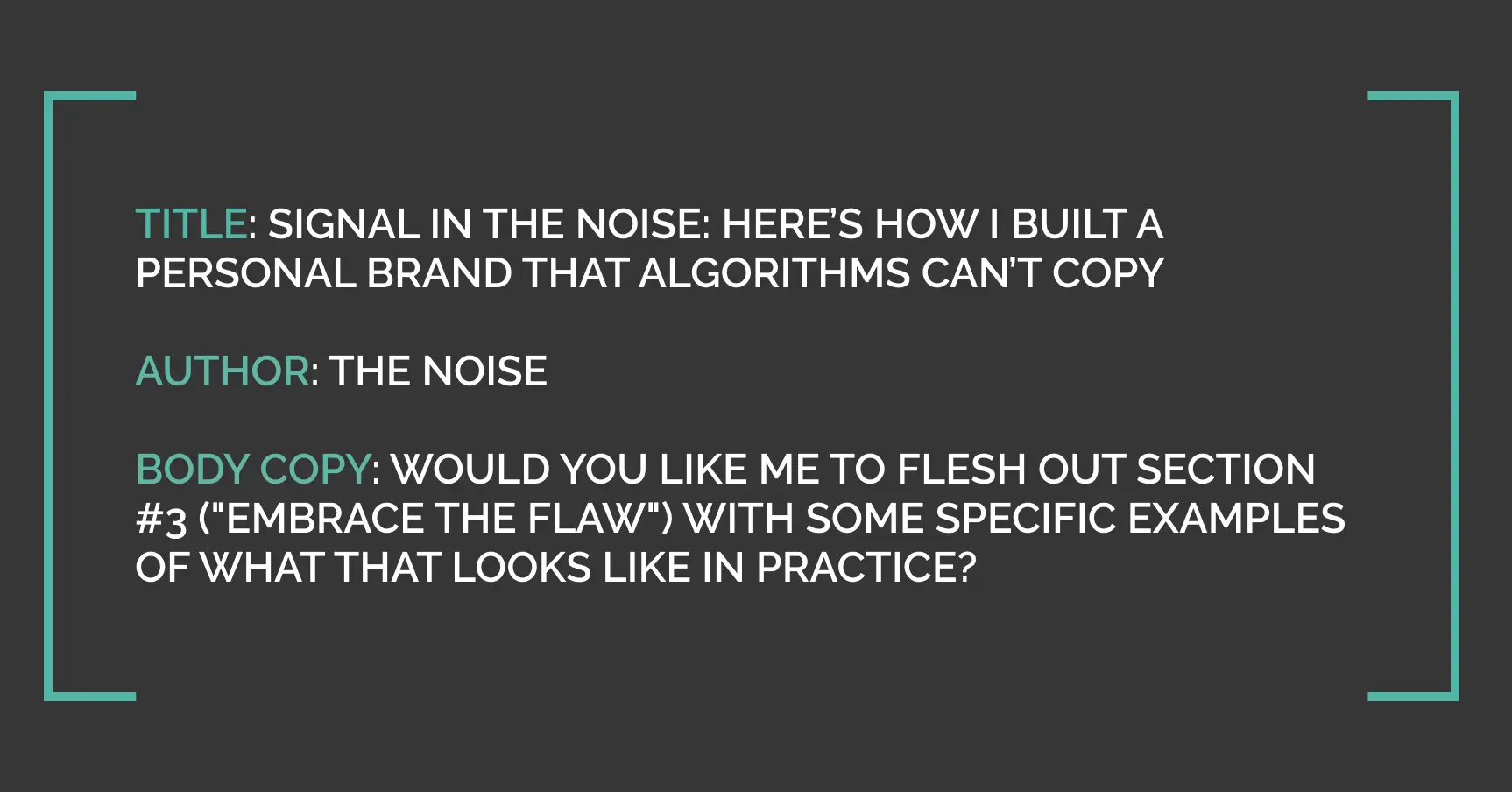 When I’m editing my (amazing, talented) content team’s work and come across a typo, I find myself paradoxically relieved. As I make the fix and prepare to leave an awkward “don’t forget spell check!” reminder, I think to myself, at least they typed it with their hands. *
Forget About Getting “Noticed.” What Will It Take to Even Get Seen?
Most marketers agree: we’re now swimming in a Pacific garbage patch of content written by nobody, for nobody. And the impact on businesses is serious. The ways many of them were used to getting noticed in the past are losing impact. LLMs eat trusty top-of-funnel SEO content for breakfast, spitting it out in anonymous overviews before lunch. The creators in the equation are left begging for citations and similar digital scraps.
For lots of businesses, this begs a fair question: How can we make sure the content we’re investing in actually reaches anyone?
You may be like me. You may sit at your desk with that question from time to time, maniacally considering inserting typos in your next post just so people think you’re real.
Desperate times, despearte measures.
But I promise you there’s a better way. Below are 7 tried-and-true marketing tips that just so happen to be up to the challenges of 2026. You already know how to act on them.
Without Further Ado: 7 Things to Try Instead of Intentionally Misspelling Stuff
1. Audit your tech stack.
If you suspect that your legacy software is costing you, you’re right. One of the first things we consistently do with new clients is consider whether their current tech serves their needs. Sticking with outdated platforms is the number one risk to your content’s visibility, not to mention your privacy and security.
Invest in an audit. Pick trustworthy, nimble platforms to deliver your content to people and algorithms. If you skip this step, it really doesn’t matter how much you’ve invested in the content itself.
2. Squeeze out a new review.
I’m well aware this is a tricky one. Some of our partners can’t legally solicit reviews from individuals. Even when it’s permissible, it can still be awkward or risky to ask. Some customers get turned off, others are picky about how you’ll use their information. Many are happy to help but simply forget, and you hate to bug them. Finding the right moment feels paralyzing.
Shake it off.
Reviews have always been vital, but there used to be ways to survive without them on the internet. Not so anymore. High-quality, high-context reviews are a primary route to winning LLM search citations—and to proving you’re not an AI scam yourself.
Is your review collection process too friction-laden for customers? Do they need more reminders or incentives? Would they be more likely to complete a review as a favor to their longtime rep? Take all the time you need to figure this out.
Stuck? Reach out to your marketing partners ;)
3. Get your customers asking more questions. Publish your answers on every platform.
This isn’t new advice, but it’s shocking how many companies don’t prioritize it. The psychology is simple: when you feel like a question is “too dumb” to ask out loud, where do you go?
Your next customer may not find the FAQ page or subreddit where you’ve answered all those “dumb” questions, but their LLM of choice will. And when that customer covertly types their ultra-specific query into ChatGPT, your brand could be there to greet them.
Is there a science behind getting more AI citations? At the moment, we’re seeing a lot of hot tips floating around on the topic. We’ll see how they play out, but I’m not here to pedal any of them today.
If your digital content serves your audience’s spoken and secret needs, and if it follows best practices for semantic structure and visibility, you probably won’t need to know the science.
4. Conduct a survey. Even a humble one. Put the results everywhere.
Congratulations—you’re now the expert author of original research in a time when people and algorithms prize it most.
SEO isn’t gone … but good, well-researched content isn’t as competitive out of the box as it used to be. Google’s EEAT (Experience, Expertise, Authoritativeness, and Trustworthiness) is now heavily weighted toward the first capital E. LLMs prioritize similarly. In 2026, no fight against the AI recycling machine is ultimately going to win if you’re not a primary source about something.
This doesn’t have to intimidate. We spend a lot of time with our clients strategizing steady, achievable wins at any company size. Want your content to show up, rank, and get cited? Find one piece of your business that you approach uniquely. Start there, and start as small as you have to.
Maybe you have the resources to conduct and publish enterprise-scale research. Maybe you can only collect a few internal stats on your projects, or send out a simple survey to some customers asking for feedback. No matter your capacity, this is where you put your effort this year. Collect and create unique stories you can tell firsthand. Publish them everywhere. (We’ll explain ways we handle that with the concept of Full Circle Content in another post).
5. Autograph everything.
We live in a culture going blind from online overexposure, and I won’t recommend anyone put still more of their personal life up for sale.
BUT if your business wants to survive the dawn of the AI epoch, be your full professional self on every page and platform. Showcase your team and their areas of expertise.
Did you write it? Link your bio. Brandish your credentials. (If you need to use ghostwriters, we’ve got ideas that can help here too. Give us a holler.)
Are you the expert? Are you developing a program or a product that is a little different from the norm in your industry? Get your name all over it!
Google has long demanded your money or your life in exchange for surfacing impactful content. At Eightfold, we’re recommending leaning into attribution and proprietary information—your “life”—like never before. It’s one of the best ways we know so far to increase your chances of being cited by ChatGPT, Gemini, and other LLMs, and it’s an increasingly vital search engine ranking signal. It’s also just common sense and good business.
If you’re a nice, humble person and it feels somehow icky, remember that this one’s for the bots.
6. Stop writing “content”. Instead, write a message to some customers. Type their real names in your doc. And good grief, don’t forget to delete them later.
This blog started not as a draft, but as a letter addressed to all my favorite clients. (Hopefully, you know who you are.)
Remind yourself often that “users,” “personas,” “traffic,” “conversions,” and “content” are just corporate-coded code for people, their decisions, and their influences. As soon as real names hit the blank page, it’s easier to switch from “creating content” to sharing ideas and services with the warm-blooded individuals who are willing to pay you for them.
7. Shamelessly write copy with any AI tool of your choosing. But then, you have to read it.
If your eyes glaze over, can you expect a better result from customers?
I’m not recommending anti-AI snobbery here. For better or worse, I’m as fully bought in as the next marketer on the idea that most of us need to become AI-fluent yesterday.
But it’s important to approach this like professionals. We’re here to produce work that’s meaningful enough for people to spend money on. Of course we’re going to use the best possible tools to do that work. But our attention should never stray from the value of the output. It genuinely doesn’t matter how the writing got done. It matters if the content means something.
If you’re tempted to remove em dashes or insert a typo so no one “thinks AI wrote it,” maybe your work isn’t at a professional level yet.
But When All is Said and Done:
The next time you hit post, send, or publish, and realize moments later there’s a stupid typo in your stupid work, comfort yourself with this thought:
Somewhere in the world, on some other screen, your worst nightmare may be coming true. Someone may actually be looking at that typo.
Someone who’s just spent their day wrangling feature-bloated software, being asked “Would you like me to mock up the text for that?” and propping their eyes open to read another ultra-polished Essential 2026 Business Checklist written By The Void, For The Void.
This person may be looking at your typo like they haven’t looked at anything in a long time.
(And now that you’re comforted, go fix it immediately. 😉)
* “…Language is the most intimately physical of all the artistic means. We have it palpably in our mouths …. Writing it, we shape it with our hands. Reading aloud what we have written—as we must do, if we are writing carefully—our language passes in at the eyes, out at the mouth, in at the ears ….
Does shaping one's words with one's own hand impart character and quality to them, as does speaking them with one's own tongue to the satisfaction of one's own ear? There is no way to prove that it does. On the other hand, there is no way to prove that it does not, and I believe that it does.”
~Wendell Berry
